Is my phone an idol? A Christian look at phone addiction
"It's become an idol. In my hand, my heart, my head." On the difference between conviction and shame, and which one changes anything.
By the Behold team · Updated
Short answer: an idol isn’t defined by how evil a thing is. It’s defined by what gets your first and best attention. By that measure most of us can answer honestly without much investigation. But the answer alone changes nothing, because guilt is a diagnosis, not a treatment. What changes things is putting prayer physically in front of the phone, so the reach that’s been costing you produces something instead.
If you searched this, you already know the answer and you’re hoping to be told otherwise. Let’s skip that part.
The honest diagnostic
Forget screen-time numbers for a minute. Ask these instead:
- What is the first thing you look at in the morning?
- What do you reach for when you’re bored, anxious, or avoiding something?
- What is the last thing you see before sleep?
- Which one would be harder to give up for a month: your phone, or your Bible?
An idol in Scripture is not usually something wicked. It’s usually something good that has quietly taken the top slot: family, work, security, reputation. The phone is unusual only in how well it hides, because it’s genuinely useful, socially required, and always in your pocket.
One way people put it, once they’ve stopped defending: “I reach for my phone over my Bible ten thousand times to one.” That ratio isn’t a confession of unbelief. It’s just a description of what your hands do.
What Scripture actually says about it
There isn’t a verse about phones, and anyone quoting one at you is stretching. But the shape of the problem is ancient:
“Seek first the kingdom of God.” First is a word about order, not about total quantity. The question isn’t how many hours; it’s what comes first.
“Set your minds on things above.” The morning feed is a mind-setting device. So is prayer. You are going to use one of them at 6:40.
“Where your treasure is, there your heart will be also.” Attention is the currency you actually spend. Look at where it goes and you have your answer without needing a study.
“All things are lawful for me, but I will not be dominated by anything.” This is probably the most exact one. Not is it sinful, but is it dominating you. You can tell. You’ve been able to tell for a while.
Why knowing this hasn’t fixed it
Here’s the part that most articles on this leave out.
You have been convicted about this repeatedly. Maybe at a men’s retreat, maybe during a sermon, maybe at 11pm on a Tuesday when you realised you’d just lost ninety minutes. And every time, you resolved to do better. And every time, within a week or two, you were back.
That pattern has taught you something you probably haven’t said out loud: I can’t change this. And each new resolution now carries the weight of all the previous failed ones.
But look at what you’ve been trying. You’ve been applying conviction to a reflex. Conviction operates on decisions. The phone habit does not run through decisions. You don’t decide to open Instagram, you find yourself in it. Applying a decision-tool to a non-decision problem produces exactly what you’ve experienced: sincere intent, no change, growing shame.
The difference matters enormously:
Conviction says this isn’t right, and here’s what to do. It moves toward action.
Shame says I am the kind of person who does this. It moves toward hiding, and hiding is where the phone habit thrives, because it’s a private failure with no witnesses.
If what you’re feeling right now is mostly shame, put it down. It has been on this job for years and hasn’t produced anything.
What actually changes it
Change the moment of the reach.
Not the resolve the night before. Not the accountability conversation on Sunday. The eight seconds at 6:40am when your hand moves before you do.
Three principles:
1. Make the block undismissible. A limit you can tap past is a notification. Your habit learns the button in three days. Whatever you use, the block screen must have no ignore button on it.
2. Put something in the hole. Blocking Instagram and leaving a vacuum just relocates the habit. The vacuum has to be filled by something better, and for a Christian the obvious candidate is the thing you’ve been failing to get to anyway.
3. Make the good thing the unlock. This is the inversion. If prayer is what opens the phone, then the reflex you’ve been at war with starts producing prayer. You stop needing to defeat it. Every reach becomes a minute with God.
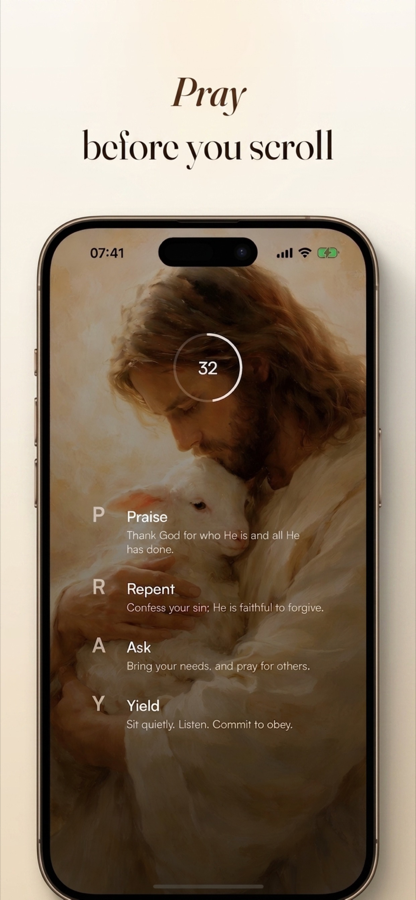
That’s the whole idea behind Behold. Set your Prayer Times, choose which apps go quiet, and they stay locked until you’ve prayed. About sixty seconds, guided, no ignore button. Not a screen-time app with a verse on it. A prayer habit that happens to use your phone habit as its trigger.
What the practice looks like
You set one Prayer Time: the morning, usually, because that’s where the wound is. You pick two or three apps: the ones your thumb finds without permission.
At 6:40 you reach for Instagram and get a block screen instead. Behold walks you through P.R.A.Y.:
- Praise. One true thing about God.
- Repent. One thing, named plainly. Not an inventory.
- Ask. For today. Specifically.
- Yield. Hand it over.
A minute. Then the phone is yours.
Notice what happened to the guilt in that structure. The reach you were ashamed of is now the thing that starts your prayer. It isn’t evidence against you anymore. It’s the doorbell.
Over the week, the Prayer Ring shows the shape of what’s actually happening: kept, missed, still ahead. Not a streak counter engineered to make you anxious. Streaks turn a missed morning into a catastrophe, and a missed morning is not a catastrophe. It’s a Tuesday.
On repentance versus self-loathing
One caution, because this is where sincere people get stuck.
Repentance is turning. It’s short, specific, and it ends with you facing a different direction. “I gave the morning to my phone again. I’m sorry. Today I’m giving it to you.” Done.
Self-loathing is long, vague, and ends with you facing the same direction, only tireder. “I’m so weak, I always do this, what kind of Christian even …” That’s not humility. It’s an unproductive loop that feels like piety.
If your prayer about your phone has become a place to punish yourself, cut it short. Name it, turn, move. There’s grace here and it’s not scarce.
The honest limits of any app
Behold runs on Apple’s Screen Time framework, like every real iPhone blocker. Anyone holding your unlocked phone can go into Settings and switch it off; no iOS app can prevent that. What Behold removes is the ignore button: the one-tap dismissal that made your old limits meaningless. The reflex lives in the one-tap zone. It doesn’t survive a deliberate trip through Settings.
And no app fixes a heart. What an app can do is stop the reflex from getting the first ten minutes, which frees up room for the actual work: prayer, Scripture, church, honest conversation.
Where to start
Don’t start with a resolution. You have made those.
Start with one Prayer Time and one app tomorrow morning, and see what a week of first-thing prayer does to the question you came here with.
Try it tomorrow morning
Set one Prayer Time. Pick one app. That is the whole setup, and it takes about two minutes.