How to build a daily prayer habit that actually sticks
Daniel prayed three times a day, on a schedule, with the windows open. Structure isn't the enemy of a real prayer life. It's how it survives.
By the Behold team · Updated
Short answer: daily prayer habits fail because they depend on remembering and on having spare time, and most days you have neither. The ones that last are scheduled (a fixed time, not “sometime today”), small (sixty seconds as the minimum, not thirty minutes), triggered by something you already do (reaching for your phone), and structured (a shape to follow so you’re never staring at a blank mind).
You’ve wanted a real prayer life for a while. You’ve started several times. It lasts nine days, or four, and then a hard week arrives and it quietly stops, and you don’t notice for a month.
That’s not a report on your faith. It’s a report on the design of the habit.
Why prayer habits fail
They depend on remembering. “I’ll pray more” has no time attached, so it competes with everything else in an unstructured day and loses. Not to sin, but to the school run and the inbox.
They’re too big. You commit to thirty minutes because that feels like the amount a serious person would do. Then you miss it twice, feel like a fraud, and stop. A thirty-minute plan you don’t do is worth less than a one-minute plan you do.
They have no trigger. Habits that stick are attached to something already happening: coffee, the commute, brushing your teeth. Prayer that floats free of any anchor has to be summoned by an act of will every single day, and will runs out.
They have no shape. You sit down, close your eyes, and your mind produces a shopping list and an argument from 2019. Three days of that and you conclude you’re bad at prayer.
They’re all-or-nothing. Miss two days and the streak is broken, and a broken streak feels like permission to stop entirely.
Fix these five and the habit stops requiring heroism.
What Daniel understood
“He got down on his knees three times a day and prayed and gave thanks before his God, as he had done previously.” (Daniel 6:10)
Read that again with an eye for mechanics. Three times a day. A number. As he had done previously. A pattern already running before the crisis hit. And the crisis was a decree that made praying a capital offence, which he met not with a burst of new resolve but by continuing something already automatic.
There’s a lesson in this that’s easy to miss if you think structure is the enemy of sincerity: the structure was what let the prayer survive pressure. Daniel didn’t have to decide, at the moment of maximum cost, whether to pray. It was already 6pm and 6pm was prayer.
The Psalms echo it: “Evening and morning and at noon I utter my complaint” (Psalm 55:17). The early church kept fixed hours. This isn’t a modern productivity hack applied to faith; it’s how prayer has survived busy, dangerous, distracted lives for three thousand years.
Building one that survives a real week
1. Pick your times, not your intentions.
Start with one. Morning, almost always, because it’s the highest-leverage slot and the one that currently hurts most. Add midday and evening later, once the first is boring.
Give the window some slack. “6:35 to 7:15” is kept. “6:35 exactly” is missed and then abandoned.
2. Set the floor at sixty seconds.
Your minimum has to be something a sick, tired, running-late version of you can still do. That’s a minute. On good mornings you’ll go longer and that’s a bonus, not the standard. The standard has to be survivable on the worst day of the month, or it isn’t a standard.
3. Attach it to something you already do without thinking.
Here’s the one people miss. You already have a completely reliable morning behaviour: reaching for your phone. It fires every single day without fail.
Most advice says fight it. The better move is to use it. If prayer sits on the other side of that reach, so that the phone doesn’t open until you’ve prayed, you’ve attached the new habit to the strongest trigger you own.
4. Give it a shape.
Use P.R.A.Y.: Praise, Repent, Ask, Yield. Four short steps so you’re never sitting in silence wondering if you’re doing it right. Prompts you can borrow when you have no words of your own. Full walkthrough here.
5. Make missing a day survivable.
You will miss days. Build for it now, while you’re calm, rather than discovering at day nine that your system treats a missed morning as a moral event.
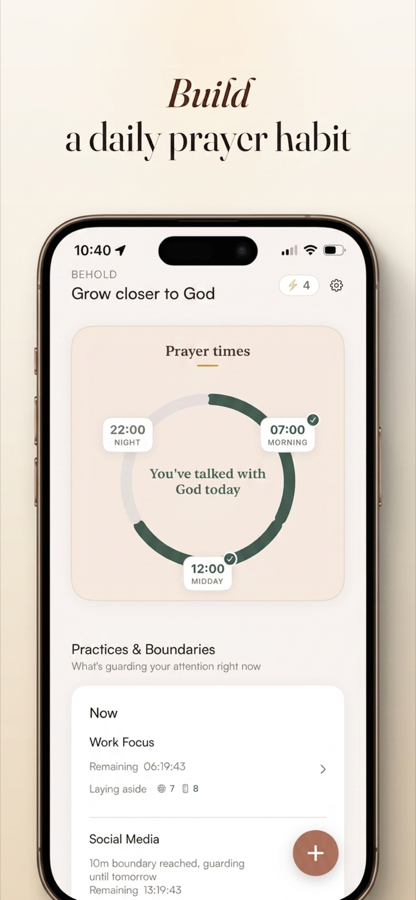
How Behold implements all five: Prayer Times (scheduled), pray-to-unlock on the apps you choose (triggered by the reach you already make), P.R.A.Y. prompts (structured), about sixty seconds (small), and a Prayer Ring that shows the week’s shape rather than a streak you have to defend (survivable).
The setup, concretely
Prayer Times. One to start. Behold blocks the apps you’ve chosen during that window, and they unlock once you’ve prayed. No ignore button on the block screen, which is the whole reason it holds when your resolve doesn’t.
The apps. Two or three: the ones your thumb opens unbidden. Instagram, TikTok, the news. Not Messages, not Phone, not Maps.
The prayer. P.R.A.Y., about a minute, guided.
The Prayer Ring. A picture of the day’s rhythm: what you kept, what you missed, what’s still ahead. Deliberately not a streak counter. Streaks make day nine terrifying and day ten pointless.
Boundaries. Daily per-app limits, for the rest of the day. Set these in week two, based on what week one actually showed you.
Practices. Protected windows (Sunday morning, dinner, small group, work hours) where the phone stays quiet regardless of whether you’ve prayed.
A realistic four weeks
Week 1. One Prayer Time, one or two apps. It will feel like an interruption for two or three days. Around day four something turns: you start praying before reaching for the phone, to get ahead of it. That’s the habit taking hold.
Week 2. Add a second Prayer Time, usually midday, or set your first Boundary. One change, not both.
Week 3. Add Practices for the fixed points of your week. Look at the Prayer Ring and notice which time of day you keep and which you drift past. Adjust the window rather than blaming yourself.
Week 4. It should be boring. Boring is the win. Boring means it’s no longer a project you’re maintaining; it’s just what happens at 6:40.
Two things people get wrong
Making it bigger too fast. After a good week the temptation is to jump to five Prayer Times and thirty-minute sessions. That’s how you get back to the nine-day pattern. Add one thing at a time, and only once the last thing is automatic.
Treating the ring as a scoreboard. The point of seeing your week is information, not judgement. If you drifted past midday four days running, the useful response is “midday is at the wrong time”, not “I’m failing at prayer.”
The honest note on the mechanism
Behold uses Apple’s Screen Time framework, so anyone holding your unlocked iPhone can disable it from Settings. No iOS app can prevent that. What’s removed is the one-tap ignore that made your old limits meaningless, and the morning reflex operates entirely in that one-tap zone.
Start tomorrow
One Prayer Time. One app. Sixty seconds. That’s a real prayer habit, and unlike the thirty-minute version, it will still be running in March.
Try it tomorrow morning
Set one Prayer Time. Pick one app. That is the whole setup, and it takes about two minutes.